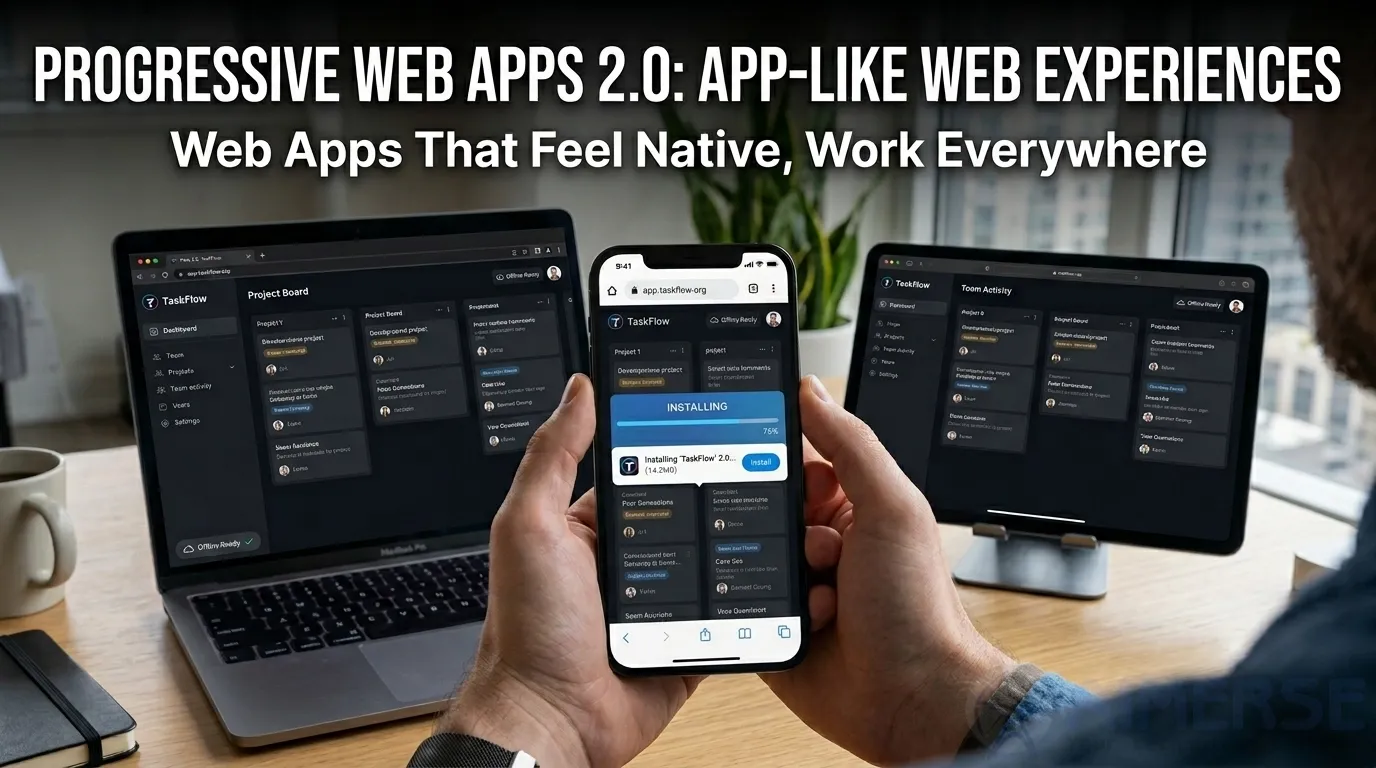
Progressive Web Apps 2.0: App-Like Web Experiences
PWAs 2.0 deliver native-like performance, offline functionality, and seamless installs directly from browsers in 2026.
PWA 2.0 utilizes the File Handle API, Periodic Background Sync, and WebGPU technologies in order to offer 60fps graphics. As a result, 36% more visitors are able to convert into installs compared to native app installs. iOS 18+ Safari supports full-fledged PWAs with push notifications. About 70% of enterprises are embracing this technology in order to avoid cross-platform development costs. Service workers cache up to 90% of the app’s payload. As a result, the app is able to load in just a second even when the user is offline.
PWA 2.0 Superpowers
- Install experience: Badges and iconography replace the traditional “Add to Home Screen” nag.
- Background tasks: Sync emails and run ML models even when no tab is open.
- WebGPU and neural capabilities: On-device AI is on par with native CoreML and TensorFlow Lite.
- File System Access: Direct access to the file system, just like native apps.
React.js PWAs contain around 200 KB of the app’s payload. Node.js is used for service workers in order to handle the syncing.
Enterprise Wins
- Retail: Starbucks’ PWA drives 83% of iOS traffic.
- News and media: Twitter’s PWA is 70% faster than the traditional Twitter app.
- Enterprise: Secure offline access for CRM through Laravel backends.
Conversions increase by 68%, and data costs are reduced by 90%.
Implementation Basics
- Manifest v3 with iconography.
- Service Worker for caching and precaching.
- Spring Boot APIs along with Web Push.
- Test on iOS, Android, and Edge.
Conclusion
PWA 2.0 is a mature technology by 2026. Native app experiences are now available across the stacks. React.js is used in order to deliver a smooth user interface. Node.js is utilized in order to handle the services. Python Django is used in order to handle the data syncing. Laravel is used in order to speed up the deployment. Java Spring Boot is used in order to secure the enterprise PWA. As a result, a universal web paradigm is available with app parity, instant access, and no downloads or fragmentation.