5G-Advanced for Private Networks.
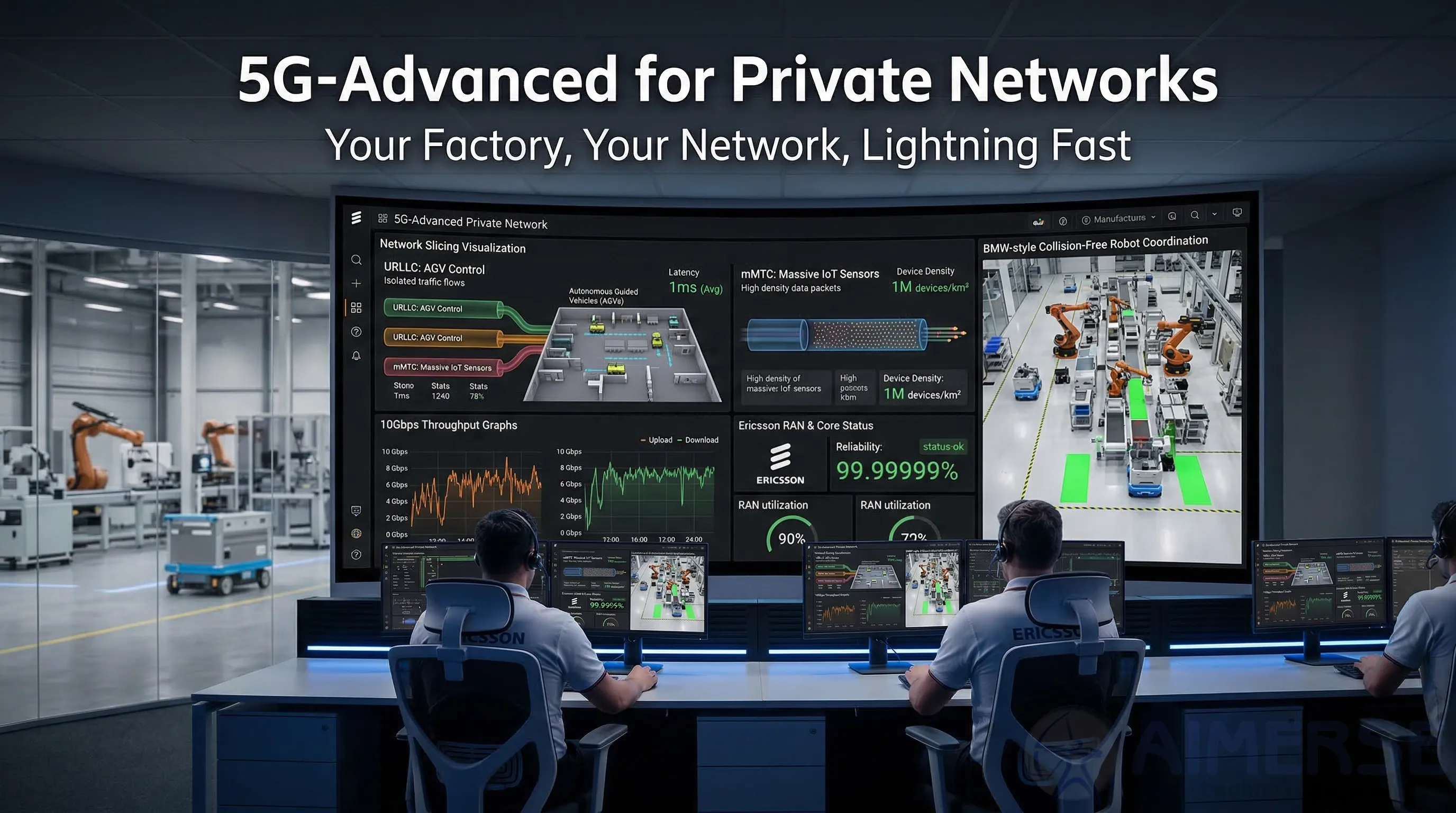
Private 5G-Advanced is expected to have its own spectrum by 2026 to enable mission-critical communications. With Rel-18, 5G-Advanced is promising 99.99999% reliability, 1 ms latency in URLLC, and 10 Gbps throughput in private 5G networks. Existing licenses like CBRS and n78 are available to enable factory and campus networks. Network slicing is also possible to provide isolated communications up to 100 slices in a network. Private 5G from Ericsson is already live in 500+ sites, and BMW is using it to manage automated guided vehicles with sub-5 ms timing accuracy.
Advanced Capabilities
- URLLC
- Deterministic performance
- Jitter < 1 microsecond
- mMTC
- Up to 1 million devices/km2
- Slicing
- QoS according to each slice
- Edge MEC
- < 10 ms
Tech Stack References
- Node.js 5G APIs
- Django Orchestration
Enterprise Use Cases
- Manufacturing
- AGVs stay in sync, safe, and within 2 ms
- Ports
- Remote crane control and 4K
- Mines
- Underground positioning accuracy < 10 cm
- ROI
- 25% throughput gain
Deployment Factors
- Auction of 3.5 GHz spectrum
- Neutral host deployments reduce costs by 50%
Roadmap
- Pilot slice deployment
- Core and RAN deployment
- 5G-Advanced upgrade
Conclusion
Private 5G-Advanced is a vision to provide a dedicated ecosystem of wireless connectivity to businesses and enterprises. With this 5G Advanced vision to arrive in 2026, Industry 4.0 is expected to reach its maximum potential in all industries due to precise, sovereign, and deterministic connectivity. Tools that are fueling this vision include React.js, Node.js, Python, Django, Laravel, and Java Spring Boot.