Generative Code AI: Beyond Copilots.
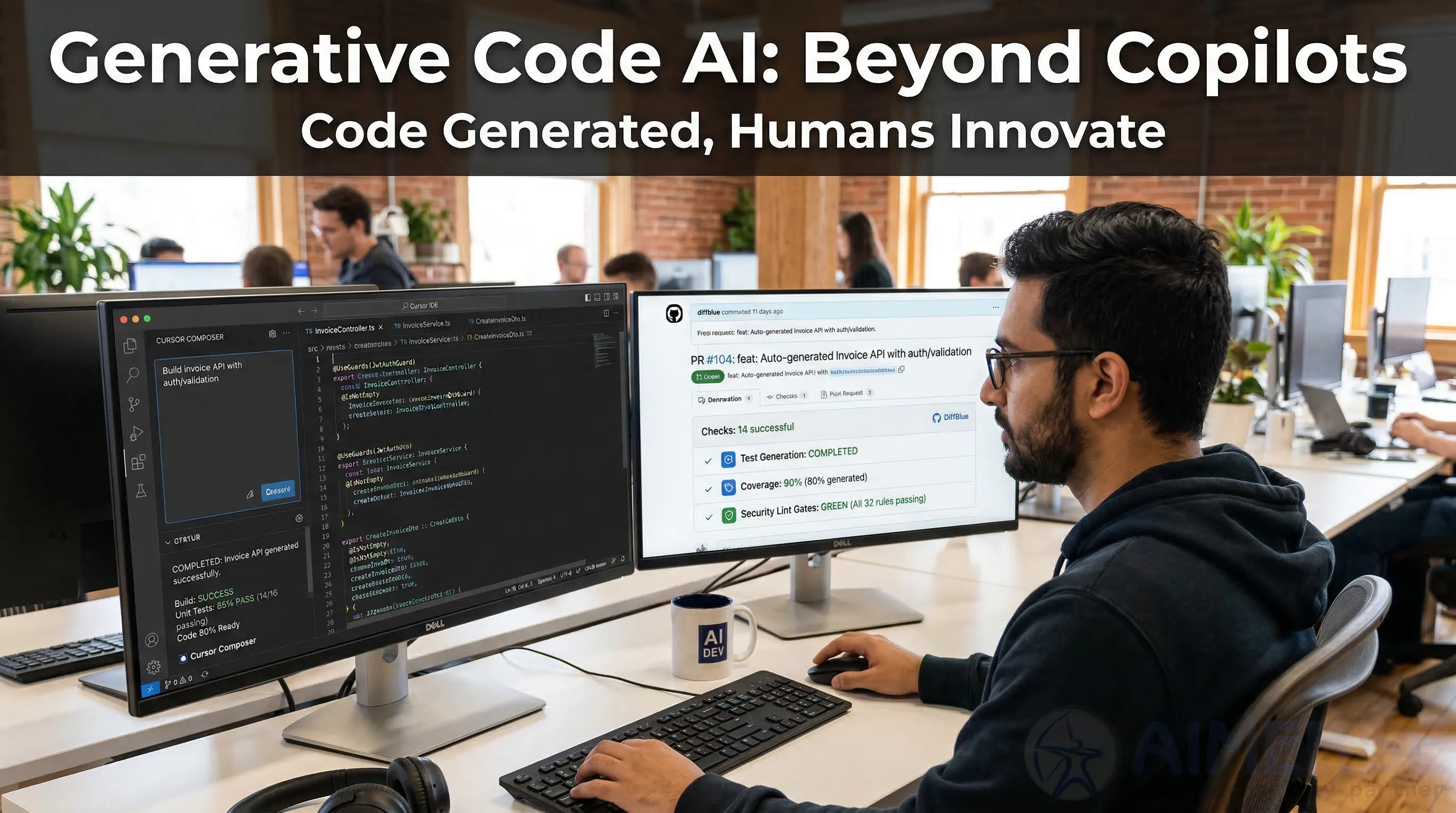
Generative AI code is changing the way we work. It can convert specifications into working code, e.g., functions and classes, speeding up code development five times over while remaining ethical. GenCode AI (Cursor Composer, Replit Agent), e.g., can convert natural language into code that is about 80% production-ready, with unit tests passing about 85%. Auto-writing tests is part of DiffBlue Cover, and Amazon Q Dev can build features end-to-end. By 2026, half of code bases are expected to be AI-generated, with humans monitoring via linters and security scanners. Ethical considerations are built in to avoid IP breaches and hallucinations.
Beyond Autocomplete
- Spec-to-Module: e.g., “Invoice API with Auth” generates CRUD ops and validation.
- Architecture: e.g., scaffold microservices that run on Docker and Kubernetes.
- Testing: auto-generate unit, integration, and end-to-end tests.
- Refactoring: e.g., safely convert monolithic code.
Django plugins and Node.js are part of the mix.
Productivity Leap
GitHub reports code changes are now 55% faster, with auto-generated tests at 90% coverage.
Risks Mitigated
- Vulnerabilities are fixed via static code analysis gates.
- IP risks are mitigated via synthetic data.
Workflow
- Start with spec prompts.
- Cycle through Gen+Review.
- Gate through CI/CD.
Conclusion
Autonomous code generation via generative code AI is changing 2026 engineering. Consider React.js-based AI dashboards, Node.js-based runtime code generation, Python Django-based validation engines, Laravel-based rapid prototyping, and Java Spring Boot-based robust and scalable code generation. The human can concentrate on code architecture, and creative acceleration is changing code development. Ethical considerations are addressed along the way.