Multi-Agent Orchestration in Business AI.
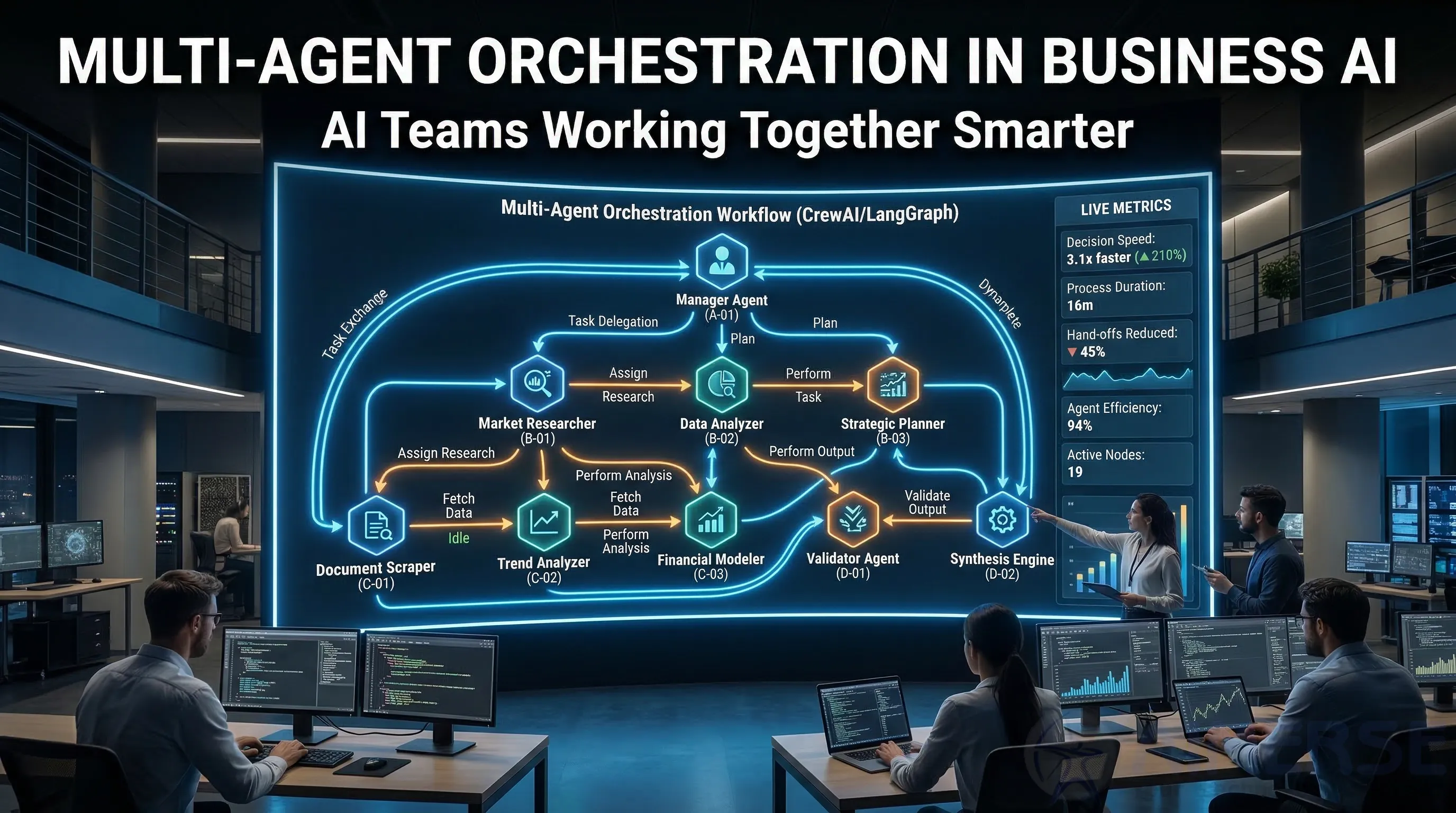
As of 2026, there are many AI agents that work together to perform end-to-end business processes. One can think of a team of special LLMs, namely researcher, analyzer, and validator, linked together using orchestration tools such as LangGraph or CrewAI. This results in a decision-making process that is three times faster compared to a single agent. One can also think of a hierarchical structure of agents, peer-to-peer collaboration, or even an event-based collaboration to perform tasks that are complex. Moreover, Deloitte also estimates that 40% of all business applications will be agentic in 2026. Having a shared memory or state is also important to keep all the agents in agreement and reduce hallucination drifts.
Orchestration patterns to know
- Hierarchical: manager and specialists.
- Sequential: pipeline of specialists.
- Parallel: multiple research teams.
- Dynamic Routing: which agent is best in a given context.
Tech stack
- Node.js is being used for coordination.
- Django is being used to manage state.
Where this matters in business
- Research: five agents are analyzing a market together.
- Code Review: multiple experts voting on a fix.
- Customer Success: workflows to solve customer problems.
What’s improved
- 45% fewer handoffs and 60% fewer errors, according to IBM.
Challenges to watch
- Agent drift due to shared memory.
- Cost increases due to parallel work; limits can kick in.
Production Checklist
- Agent design and guardrails.
- Observability with traces.
- Humans in the loop.
- A/B tests against a single agent baseline.
Bottom Line
Multi-agent orchestration is a technique that scales AI in 2026 using collaborative intelligence. It is done using React.js to create a workflow dashboard, Node.js to perform coordination in real-time, Python and Django to create state engines, Laravel to create prototypes quickly, and Java Spring Boot to create reliable applications.