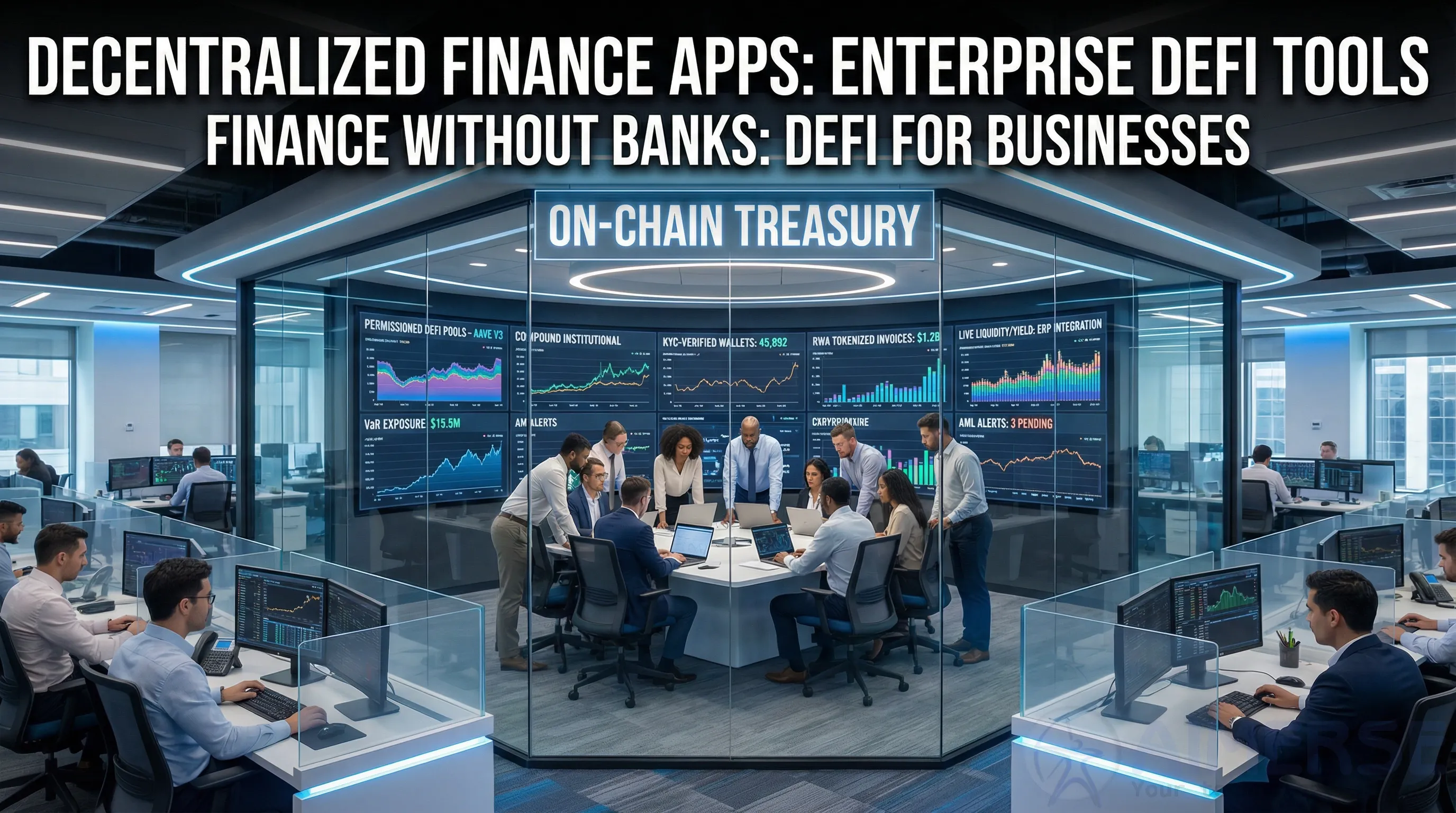
Decentralized Finance Apps: Enterprise DeFi Tools.
Enterprise DeFi offers regulated lending solutions and tokenization services to banks and enterprises. DeFi has stopped being just a buzzword; instead, it has been put to use in production by financial institutions. Banks and financial institutions are making use of DeFi for lending and tokenization. Tools designed for enterprise use cases leverage trusted DeFi protocols such as Aave, Compound, and MakerDAO and then add the additional features and functionalities that are important for regulated financial institutions.
What Makes DeFi Enterprise-Grade?
Compliance Layer
- Permissioned Pools: This involves the use of KYC/AML checks and the imposition of rules and restrictions on the participants to ensure only approved and verified individuals or firms are allowed to participate in the process.
- Permissioning: This involves the imposition of control over the participants and the rules and regulations governing the process.
- Policy: This involves the imposition of rules and regulations on the DeFi market, which are then enforced on the participants.
Risk & Monitoring
- On Chain Analytics: This involves the use of on-chain analytics for the monitoring of the DeFi market.
- VaR: This involves the use of on-chain Value-at-Risk calculations to keep track of the levels of risks associated with the smart contracts.
Integration Readiness
- APIs: This involves the use of APIs and SDKs, which are then integrated with the existing ERP and fintech ecosystem.
- Integrations: Simple and seamless integrations with existing technologies employed by banks and organizations.
- Treasury and liquidity: Yield strategies, real-time dashboards for finance teams, and well-defined risk limits.
- Tokenized assets and invoices: The invoicing, inventory, and revenue streams are converted into tokens with multiple financing options across platforms.
Implementation Considerations
What Enterprises Need
- Governance and compliance models according to jurisdiction.
- Secure integration to connect smart contracts with existing technologies using an API-first and cloud-native approach.
- Strong emphasis on security measures, such as audits and monitoring, to protect against potential risks.
Conclusion
With the development and advancement of DeFi technology, which will eventually become enterprise-grade infrastructure, businesses are turning to trusted technology stacks that simplify, increase transparency, and enhance control. Using the right technology stack, which includes React.js for the front end, Node.js or Python Django for integration and orchestration, Laravel for administration, and Java Spring Boot for the back end, organizations can build custom DeFi applications that remain compliant. The decentralized infrastructure runs in the background, allowing the finance team to be more efficient.